When a limb snaps in a windburst and lands across your driveway, you realize how fast a healthy landscape can turn into a hazard scene. The physics are unforgiving. A 12 inch diameter oak limb can weigh a few hundred pounds. Under tension or hung up in a neighboring canopy, it behaves like a spring with a temper. The right response in the first hour makes the difference between a safe cleanup and a second emergency.
I have spent enough wet nights and long mornings with crews to know that tree emergencies do not respect business hours. They also do not play fair. Limbs fail on the blind side of a house. Root plates heave toward utility lines. Rotten sections hold just long enough to tempt someone under them with a chainsaw. There is a practical way to handle these scenes, and it is built from a mix of quick triage, sound arboriculture, and patience.
Why limbs fail, even on seemingly healthy trees
Most storm failures https://troyhbmc315.theburnward.com/real-time-dangerous-tree-assessment-and-removal-after-storms trace back to a handful of stressors. Storm load on a heavy crown is the obvious culprit, especially when leaves are on. A saturated root zone reduces anchorage. Frost cracks open during a thaw and later split under wind cycling. Old topping cuts lead to weakly attached sprouts. Co-dominant stems with included bark are a classic hinge point. In hot summers, dieback sneaks into the upper crown, dries the wood, and, months later, a normal breeze does the rest.
Species matter. Soft maples and poplars shed long, unwieldy sections. Willows and cottonwoods drop undercompartmentalized wood at imperfect unions. Pine limbs that were once loaded with snow harden into levers, and when one goes it often rips a long strip of cambium with it. I have also seen excellent oaks and beeches fail at one hidden defect after decades of looking stout. Visual vigor, while helpful, is not a guarantee.
Human activity primes many failures. Overmulching suffocates roots and invites girdling roots. Grade changes alter drainage near trunks. Poorly placed patio footings sever roots in the top 18 inches where most of the structural support lives. Unbalanced pruning to please a view concentrates sail force to one side. Each choice has a cost, often paid during a wind event.
First hour priorities when a limb is down or hanging
Panic tempts shortcuts. I have watched a homeowner put a ladder under a cracked limb and start cutting from the bottom. Within seconds, the kerf pinched the bar and the limb swung, kicked the ladder, and chewed a gutter. No one was hurt, but the repair bill tripled. A calmer approach is simple and safer. Use the time before the crew arrives wisely.
- Keep people, pets, and vehicles out of the drop zone. Barricade with cones, trash bins, or rope if needed, and do not stand under a hung limb to size it up. Cut power at the breaker if service lines are involved and call the utility. Do not approach energized lines or assume a limb insulates anything. Photograph the damage from multiple angles for insurance, then step back. Avoid moving debris unless it is small, stable, and not under tension. If the limb pierced a roof, place a bucket under drips and use a tarp if it can be done from inside safely. Do not climb on a storm stressed roof. Call Emergency Tree Services that provide 24 hour dispatch and ask for a Certified Arborist Consultation to triage risk and secure the site.
Those five steps cover the vast majority of preventable secondary damage. They also keep adjusters and utilities cooperative, which matters when schedules stack after a regional storm.
Knowing what is unsafe to handle yourself
I meet many capable people who can run a saw and have cut a lot of firewood. Emergency work is different. A partially failed limb is loaded with tension and compression in ways that the bark hides. A cut in the wrong spot can release that energy into a kickback, a roll, or a swing. Ground that looks level may be slick clay. The limb that appears light might be pinned by a hard angle in the crown above, ready to drop once you remove the wrong brace. Add power lines, propane tanks, or glass, and the risks multiply.
As a rule of thumb, if the limb is larger than you can move with two hands, if it is suspended, or if it intersects a structure or conductor, treat it as a professional job. Even when the wood is on the ground, watch for green limbs that spring as you relieve weight along their length. Seasoned crews use wedges, cribbing, and sequence cuts to manage these forces. There is also the matter of insurance. Many policies exclude damage that results from non-licensed work on a structure after a reported loss, and adjusters know the difference between an emergency patch and a botched cut.
What a professional emergency response looks like
Good Emergency Tree Services start with a quick Dangerous Tree Assessment and Removal plan. The first technician on site will usually walk the scene, look up into the canopy, and trace the load path of the failed limb. They will mark tension points with paint or chalk, then clear a few escape paths on the ground and communicate a plan. Radios are not for show. If a cut goes wrong, everyone needs to know where the wood can swing.
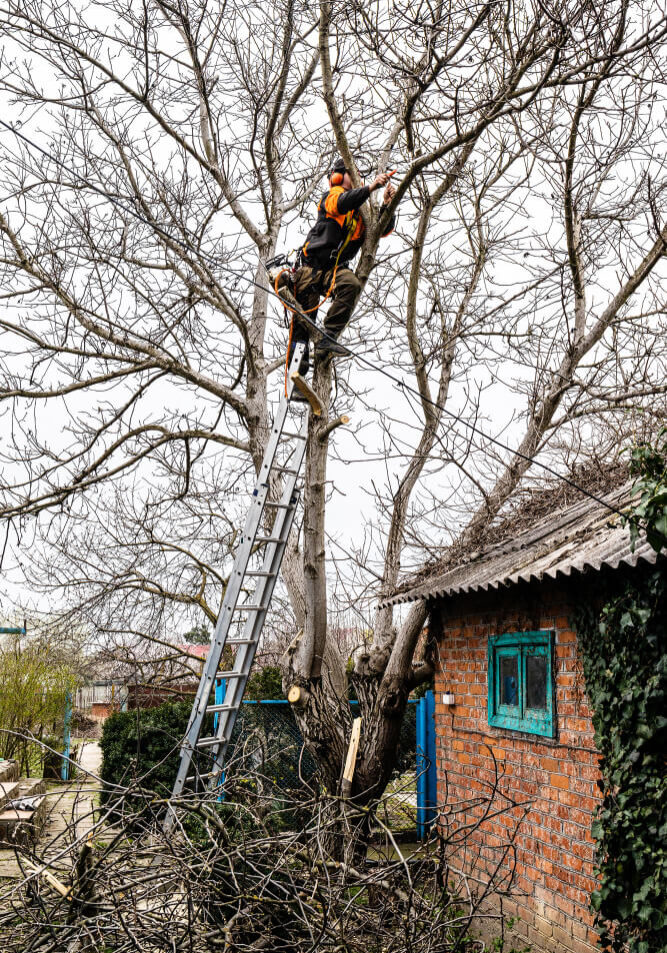
Gear matters. For night events, I prefer balloon lights over headlamps, since they reduce harsh shadows. We deploy rigging lines rated well above the expected load, friction devices anchored to base trees or steel bollards, and blocks to control swings. If the limb is hung high, a climber ascends with a double rope system or a stationary rope system and sets redirects that share load to two or three points in the crown. Sometimes the safest answer is a crane. A certified operator can float a limb off a roof in one clean lift, and the total time on site drops by hours. That said, cranes introduce their own risks on saturated soil, and outriggers need solid cribbing. A seasoned crew knows when to decline a lift and rig down in smaller sections.
The cut sequence for a hung limb usually begins with a small kerf to read the bind. If the saw pinches, we stop and change the plan. Relief cuts, step by step, take weight without shocking the system. On the ground, a spotter watches the canopy and the rigging, not the sawyer, so someone sees the big picture. Once the limb is in the clear, we pivot to cleanup, tarping, and, if needed, temporary bracing for damaged frames.
Costs, timing, and what drives both
Emergency work rarely lands in the cheapest part of a company’s rate sheet. Night calls, crane mobilizations, and skilled climbers push costs up. A basic hang up with easy access might run a few hundred to a couple thousand dollars. Complex removals over a roof, with crane support and utility coordination, often land in the several thousand range. Crews bill for time on site, equipment, and disposal. Stump Removal & Grinding, if needed after a full tree failure, adds a separate line item, typically priced by diameter and access.
Two factors drive timing: weather and triage. After a big blow, good companies triage life safety first, then property protection, then convenience. A limb on a fence will wait if another job involves a blocked egress or an energized service drop. Ask the dispatcher for a window and a text when the truck is en route. Many firms keep one crew on roving duty during storms precisely to reduce those uncertain waits.
The value of a Certified Arborist Consultation
Not every fallen or hanging limb means the tree must come down. A Certified Arborist Consultation matches symptoms with biology and biomechanics. An arborist will evaluate wound size, location, decay risk, species response, and the tree’s overall structure. A properly sized pruning cut outside the branch collar creates a solid path to compartmentalization. A ripped trunk with a long, vertical tear is a different story. So is a co-dominant union that shows fresh separation and included bark.
Clients appreciate straight talk here. I have recommended saving a storm damaged beech with a crown reduction of 10 to 20 percent, combined with Tree Cable and Bracing to secure a suspect union. In another case, a silver maple with severe heart rot at the root flare had to go, despite a green canopy. The limb failure was a symptom, not the disease. Dangerous Tree Assessment and Removal is about risk, not just aesthetics. The best arborists quantify likelihood of failure and consequences, then give you a spectrum of choices instead of one canned answer.
Pruning and crown management that prevent the next emergency
Tree Pruning & Crown Shaping is where prevention pays off. A strong structure starts early, with a single dominant leader, good branch spacing, and wide attachment angles. On mature trees, the goal shifts to reducing lever arms and balancing sail. I lean on reduction cuts over heading cuts to keep the tree’s natural form while shedding weight. Opening the interior lightly reduces wind load without turning the crown into a parachute. Avoid lion’s tailing, which strips interior foliage and pushes all weight to branch tips. That practice invites whip and failure.
Timing and tools matter. Late winter or early spring pruning on most deciduous species gives clean cuts and visible structure, though oak wilt and other region specific pathogens may dictate different windows. In urban settings, I often schedule a multi year plan, taking 10 percent one year, evaluating response, then adjusting. This keeps the tree stable and avoids shock. Documenting what was removed and why sets a baseline for future assessments.
When cabling and bracing make sense
Tree Cable and Bracing can extend the life of a valued tree with moderate structural defects. A well placed dynamic cable between co-dominant stems reduces movement and redistributes load during wind events. Through bolts and braces can secure split unions when decay is not advanced. These are not shortcuts. They require precise placement, correct hardware, and follow up inspections every one to three years. I install cables high in the crown, about two thirds of the distance from the union to the tips, and I use appropriately sized hardware based on a calculated load, not guesswork.
The trade off is ongoing responsibility. A cabled tree that is not maintained can become more hazardous than it was before the install. Hardware loosens, trees grow, and systems need retensioning or replacement. I explain that commitment upfront. For prized specimens, the cost is often small compared to the value of shade, history, and curb appeal.
FireSmart thinking around limbs and proximity to structures
FireSmart Tree Services get more attention every dry season, and for good reason. A limb touching a roof is not just a wind hazard. It is a ladder fuel. For homes in the wildland urban interface, I advocate a lean and clean zone of five feet around the structure, no combustible mulch, and crowns lifted to reduce ladder effects. This does not mean moonscaping. It means thoughtful spacing, crown separation, and removal of deadwood that can carry embers into eaves. Some clients worry that pruning for fire safety will make trees look unnatural. I am careful to preserve form while meeting clearance targets. The result is a landscape that looks cared for rather than stripped.
Working with insurance and utilities after a limb failure
Documentation smooths most claims. Adjusters want dates, photos, and invoices that distinguish between emergency stabilization and elective upgrades. If a crew tarps a roof, installs temporary bracing, and removes a limb from a structure, keep those receipts separated from longer term Tree Removal Services or landscaping that might not be covered. If a utility line is involved, coordinate closely. In many regions, the utility will drop a service line for a short window so a crew can work safely, then restore it the same day. That cooperation depends on scheduling and clear roles. A good tree service will handle those calls and build them into the work plan.
How crews decide whether to remove the whole tree
Homeowners often ask whether a single limb failure is the first domino in a full decline. Sometimes yes. More often, it is a correctable defect. The decision hinges on root health, decay extent, species resilience, and targets. A backyard willow with a history of limb drop over open lawn can remain with pruning and monitoring. A roadside silver maple with trunk decay facing a bus stop is a different risk profile.
Dangerous Tree Assessment and Removal considers both probability and consequence. If the tree’s likelihood of failure in the next one to three years is moderate to high and the target is constant, removal becomes responsible. When the decision is removal, I encourage thinking through the entire process, not just the fall. Access, mats to protect turf, sectioning to preserve hardscape, and Stump Removal & Grinding all affect the experience and the final look. A clean grind to 6 to 12 inches below grade, followed by topsoil and seed, sets up replanting in the right spot rather than another emergency later.
Aftercare once the limb is gone
The most overlooked step after a limb failure is caring for the wound and the rest of the tree. Paints and sealants are old news. Trees prefer clean, precise cuts just outside the branch collar so they can compartmentalize naturally. If the break left ragged fibers, a finish cut by a trained arborist helps. Then the tree needs water when the soil is dry, mulch in a thin, even layer out to the dripline, and no mulch volcano against the trunk. Fertilizer is not a bandage. I only recommend soil amendments after a test shows a specific deficiency. If the failure was tied to soil compaction or grade change, address that first with air spading, radial trenching, or other decompaction methods.
Monitoring matters. I schedule a follow up visit in six to twelve months to reassess the union, look for new cracks, and plan any light Tree Pruning & Crown Shaping to balance regrowth. If cables or braces were installed, I check tension and hardware integrity. Trees tell you how they are coping if you look closely and often.
Preventative steps that reduce emergency calls
Not every disaster is preventable, but you can tilt the odds. Start with a yearly walk under your canopy with a real checklist. Look for mushrooms near the base that signal decay, cracks that catch a fingernail, seams in bark that were not there last season, or sawdust at exit holes from borers. Watch how the tree moves in a moderate wind. Erratic whip at one union hints at a future problem. Keep irrigation hoses out of the root flare. Educate lawn crews to avoid turf scalping and trunk strikes, which open infections. If you are planning a renovation, bring in an arborist during design, not after the trench is cut. A Certified Arborist Consultation on the front end costs less than fixing root damage later.
A short field story: what went right, and why
A summer squall rolled through one evening and a red oak left a 20 foot limb on a homeowner’s porch roof. No injuries, but the limb nested against a dormer window and hung over the front steps. The owner did two smart things. He kept everyone inside and called a company that offered Emergency Tree Services with a live dispatcher, then he sent three wide angle photos with a note that no lines were involved. We arrived with a three person crew and a small crane within two hours. The spot to set the crane was tight, but dry enough with mats. The climber set a balancing sling on the limb because its center of mass was tricky, and we lifted just enough to clear the shingles. One clean cut at the branch collar freed the piece. We staged it in the driveway, tarped a small puncture in the roof, and the same crane helped us move the log to the street for pickup. Total time on site was under three hours, damage was limited to two broken shingles and one dented gutter, and the homeowner’s insurer covered the emergency portion. Two weeks later, we returned to perform a crown reduction of 15 percent and install one cable on a co-dominant union. That oak is still standing, and the next storm caused no issues.
Choosing the right partner before you need one
Shopping for Tree Removal Services or emergency response while a limb dangles over a nursery window is a poor time to ask hard questions. Vet a company in advance. Look for ISA Certified Arborists on staff, proof of liability and workers’ compensation insurance, and clear language about after hours response. Ask if they handle utility coordination. For complex properties, schedule a baseline assessment and map out priority trees. If a company also offers Stump Removal & Grinding, Tree Pruning & Crown Shaping, Tree Cable and Bracing, and FireSmart Tree Services, you gain continuity across prevention, response, and recovery.
Price matters, but clarity matters more. A transparent quote that notes access limits, haul off, and surface protection beats a vague low number that grows with every new surprise. References from neighbors who have used the same firm for both routine work and emergencies carry weight. Crews that perform well on a calm winter pruning day are usually the ones you want during a July thunderstorm at 2 a.m.
A short homeowner checklist for calm readiness
- Keep the number of a reputable tree service with 24 hour Emergency Tree Services saved in your phone, and verify they have ISA Certified Arborists. Photograph your large trees in leaf and leaf off seasons, then file them. Baseline images help with later assessments and claims. Trim back limbs that touch or hover within a few feet of roofs and service lines, scheduling Tree Pruning & Crown Shaping outside peak storm seasons. Walk the property each spring and fall and note changes in bark seams, mushrooms at the base, or cracks. Schedule a Certified Arborist Consultation if anything looks new or suspicious. Know where your electrical main shutoff is and teach other adults in the home how to use it safely.
When removal is the responsible choice, finish the job well
If the assessment points to removal, commit to doing it cleanly. That means safe dismantling, careful rigging, and full debris removal. It also means Stump Removal & Grinding to prevent regrowth of weak sprouts and to prepare the site for a better suited species. If roots have heaved a walk or invaded a drain line, coordinate with a plumber or mason so the sequence works. Work that looks easy from the curb takes forethought. When the last chip is swept and the soil is leveled, plant something that matches the site. Right tree, right place is not a slogan. It is the single best defense against the next emergency.
Final thought from the field
Trees give more than they take. They shade, hold soil, block wind, and steady a neighborhood’s look. Emergencies are the exception, not the rule, but they are part of living with large, living structures near our homes. Handling a fallen or hanging limb calls for steady nerves, a few simple actions to reduce risk, and, often, a call to people who do this work every day. With the right partner, you can turn a chaotic afternoon into a controlled operation, then pivot to prevention so the next storm is just background noise.
Ace Tree Services Ltd.
Name: Ace Tree Services Ltd.Address: 4656 Wallace Hill Road, Kelowna, BC
Postal code: V1W 4C2
Phone: 250-212-9593
Website: https://acetree.ca/
Hours:
Monday: 7:00 AM - 5:00 PM
Tuesday: 7:00 AM - 5:00 PM
Wednesday: 7:00 AM - 5:00 PM
Thursday: 7:00 AM - 5:00 PM
Friday: 7:00 AM - 5:00 PM
Saturday: 7:00 AM - 5:00 PM
Sunday: Closed
Open-location code (plus code): RHF8+8G Kelowna, British Columbia, Canada
Map/listing URL: https://www.google.com/maps/place/Ace+Tree+Services+Ltd./@49.8232606,-119.4337283,659m/data=!3m2!1e3!4b1!4m6!3m5!1s0x537d8b1d074815c5:0x450b88afa7a41435!8m2!3d49.8232606!4d-119.4337283!16s%2Fg%2F11ydkpnh22
Embed iframe:
"@context": "https://schema.org", "@type": "HomeAndConstructionBusiness", "name": "Ace Tree Services Ltd.", "url": "https://acetree.ca/", "telephone": "250-212-9593", "address": "@type": "PostalAddress", "streetAddress": "4656 Wallace Hill Road", "addressLocality": "Kelowna", "addressRegion": "BC", "addressCountry": "CA" , "openingHoursSpecification": [ "@type": "OpeningHoursSpecification", "dayOfWeek": "https://schema.org/Monday", "opens": "07:00", "closes": "17:00" , "@type": "OpeningHoursSpecification", "dayOfWeek": "https://schema.org/Tuesday", "opens": "07:00", "closes": "17:00" , "@type": "OpeningHoursSpecification", "dayOfWeek": "https://schema.org/Wednesday", "opens": "07:00", "closes": "17:00" , "@type": "OpeningHoursSpecification", "dayOfWeek": "https://schema.org/Thursday", "opens": "07:00", "closes": "17:00" , "@type": "OpeningHoursSpecification", "dayOfWeek": "https://schema.org/Friday", "opens": "07:00", "closes": "17:00" ], "geo": "@type": "GeoCoordinates", "latitude": 49.8232606, "longitude": -119.4337283 , "hasMap": "https://www.google.com/maps/place/Ace+Tree+Services+Ltd./@49.8232606,-119.4337283,659m/data=!3m2!1e3!4b1!4m6!3m5!1s0x537d8b1d074815c5:0x450b88afa7a41435!8m2!3d49.8232606!4d-119.4337283!16s%2Fg%2F11ydkpnh22"
Ace Tree Services Ltd. provides professional tree removal, pruning, stump grinding, emergency response, and arborist consultations for properties in Kelowna and across the Okanagan Valley.
The company works with homes, commercial properties, and municipal settings where tree work needs to be planned carefully around buildings, fences, driveways, landscaping, and other site constraints.
Based in Kelowna, the team is positioned to help nearby neighbourhoods and surrounding Okanagan communities with routine tree care and time-sensitive storm cleanup.
Customers looking for careful tree work often want a crew with certified arborist training, insurance, and a methodical approach to higher-risk removals.
Services also include dangerous tree assessment, cabling and bracing, and wildfire risk reduction tree work for properties that need longer-term planning.
To request a quote or discuss tree care options, call 250-212-9593 or visit https://acetree.ca/.
A public map listing is available to help customers confirm the business location and get directions before a site visit or estimate.
For Kelowna property owners who need pruning, removals, or emergency tree help, a local tree service can make it easier to schedule site-specific recommendations and cleanup.
Popular Questions About Ace Tree Services Ltd.
What services does Ace Tree Services Ltd. provide?Ace Tree Services Ltd. lists tree removal, stump removal and grinding, tree pruning and crown shaping, emergency tree service, arborist consultation, dangerous tree assessment and removal, cabling and bracing, and wildfire risk reduction tree work.
Who does Ace Tree Services Ltd. serve?
The company describes its work as serving homes, businesses, and municipalities in Kelowna and across the Okanagan Valley.
Is emergency tree help available?
Yes. Emergency service is listed for downed or uprooted trees, dangerous tree assessment, stabilization work, and branch cleanup. If a tree is near power lines, the safest first step is to stay clear and contact the utility provider before any tree work begins.
Do I always need a permit to remove a tree?
Not always. Permit requirements can depend on where the tree is located and whether it is near a creek, lake, steep slope, or another protected area. It is best to check local rules for the specific property before removal work starts.
How deep does stump grinding usually go?
Standard stump grinding is typically described as going about 6 to 12 inches below ground level, which is often enough for grass or surface landscaping. Deeper grinding may be possible when site plans call for it.
How much of a tree can be safely removed at one time?
That depends on the species, age, health, and structure of the tree. In practice, good pruning is usually about removing the right limbs for health, clearance, and structure rather than chasing a fixed percentage.
What are common signs that a tree may be dangerous?
Large dead limbs, visible cracks, a new lean, root damage, canopy dieback, or storm-related damage can all be warning signs. Trees near structures deserve extra attention when any of those issues appear.
What is cabling and bracing in tree care?
Cabling and bracing are support systems used to reduce the risk of failure in trees with structural weaknesses that may still be worth preserving. They are generally used to add support, not to replace good assessment and ongoing maintenance.
How do I contact Ace Tree Services Ltd.?
Call 250-212-9593.Website: https://acetree.ca/.
Landmarks Near Kelowna, BC
Downtown KelownaThe downtown core is a practical reference point for lakefront neighbourhoods, mixed-use streets, and central residential properties. If your property is near downtown, tree pruning, removals, and cleanup can be planned around tighter access and nearby structures.
Knox Mountain Park
This well-known park north of downtown is a recognizable landmark for nearby homes and hillside properties. If you are close to this area, ask about tree assessment, trimming, or removal work suited to sloped sites.
Mission Creek Greenway
The greenway runs through several parts of Kelowna and is a useful landmark for nearby residential areas. If your property borders or sits near this corridor, site-specific tree planning is especially important.
Pandosy Village
Pandosy is one of Kelowna’s most recognizable neighbourhoods and a common reference point for south-central properties. If you are nearby, request help for pruning, removals, or storm cleanup around homes and small commercial sites.
Rutland
Rutland is a major east Kelowna neighbourhood with a mix of residential and local commercial properties. If you are located in or near Rutland, tree work can be scheduled for both routine maintenance and urgent situations.
Landmark District
This central business-focused area is a practical landmark for offices, service properties, and nearby residential streets. If your site is near the district, ask about careful tree work around parking, access lanes, and built-up lots.
Kelowna’s North End
The North End sits on the edge of downtown and is a useful reference for nearby homes, industrial sites, and commercial properties. If you are in this part of the city, request tree care based on the layout and constraints of the lot.
Airport District
The Airport District is a recognizable north Kelowna reference point for surrounding properties and access routes. If you are in this area, ask about tree services for residential acreage, commercial sites, or roadside cleanup needs.
Glenmore & Dilworth
These established Kelowna neighbourhoods are useful landmarks for central and north-central service calls. If your property is nearby, pruning and removal work can be tailored to mature trees and established landscapes.
Highway 97 Corridor
Highway 97 is one of the city’s main travel routes and a common way to describe location within Kelowna. If your home or property is just off the corridor, a clear landmark reference can help speed up quote scheduling and site planning.